

The Destruction of The False Hero
A REFLECTION AND A DRAWING

It seems we are living in the Age of Fallen Heroes, when someone we admire is suddenly revealed to be a monster. Don’t get me wrong, I am very aware that we all have an ugly hidden side, but what’s been discovered about these “heroes” goes beyond merely being rude or nasty-tempered. The one I am referring to today is Neil Gaiman, even though he’s not been declared guilty yet, the number of victims, the amount of accusations, and most importantly, his reactions to all of it, make it difficult not to believe it’s true.
A Wound Beyond Repair
Years ago, I overcame the phase of admiring sports stars and athletes. More recently, and precisely since the outbreak of news of abusive people in the film industry of 2017, I tried to reduce my fandom over actors—after all, they make a living on acting as someone they are not. However, Neil Gaiman’s case hit me differently. (If you are curious about what these allegations are, you can read them in this article, but be warned that it contains very explicit testimonies of his victims that can be shocking to many readers). Despite only having read one of his works, —Neverwhere— which I enjoyed a lot, I took his Masterclass in 2019. Needless to say that I found it truly inspiring, it impacted me so much to the point that encouraged me to start writing short stories myself. So, even though I was not a long time fan —as in the case of fellow Substack author Cooper D Barhan who has a very profound essay where he describes his experience —, Gaiman was my recently adopted hero. I had plans to read more of his books, plans that now seem very hard to accomplish.
Many writers, authors, or even influencers have shared their grieving experience after learning Gaiman’s allegations, probably because the overall message of his works and public image was the opposite of what he’s done in real life, almost as if he’d come out as a villain from his own stories. This is what I believe has hurt people the most, the sense of treason; we feel backstabbed, and I don’t think there’s a way to mend it back.
We might be the root cause, but also the solution.
Since humanity’s understanding of the world around us increased, in parallel of the decay of traditional religions to keep up with this understanding, we have reached a point where we are in an urgent need of guidance, inspiration, leadership, and in this desperation, we have elevated celebrities, athletes, artists—and more recently, entrepreneurs and tech gurus—to the heights of idols. Nevertheless, the same understanding who birthed the technology that paved the way for these figures to rise, has also allowed information to flow more freely, and it’s this flow that also help to unveil the true nature of these “fallen angels.” Never know your heroes, says the popular phrase, but even though is not always true, it feels more current than ever —Please, check the magnific essay by Heaven, in the same context of Neil Gaiman’s accusations, where she shares her own heartbreaking experience of getting disappointed by Amanda Palmer, Neil’s ex-wife.
I won’t go into more details about this case, the essays and articles I’ve shared above provides plenty of great information about them. What I really want to talk you about is that we should reflect on the concept of hero we cherish and realize that we need to make a change, we cannot keep building a society that gives fame and power to this people only because their public image and work “resonate” with us. The worship of modern concepts of success is one of the main reasons that keeps us adoring these false heroes, because they have achieved what we think we need to achieve. Now, more than ever —In the times of AI sneaking anywhere—, it should be a time of a human Arts Renaissance, one that breaks the head of the current false idol and replaces it with a set of core values that we, as humanity, have managed to unlock throughout our history; a world of consciousness, accountability and love.
The hero is an archetype linked to us humans; we cannot live without it. However, we can change who we elevate to this status. We can also take this chance to become a hero or heroine ourselves. One the new generations truely deserve, not someone who stands out for the amount of success achieved, but one that emobies core values that we as a society agreed on having.
ABOUT THE DRAWING
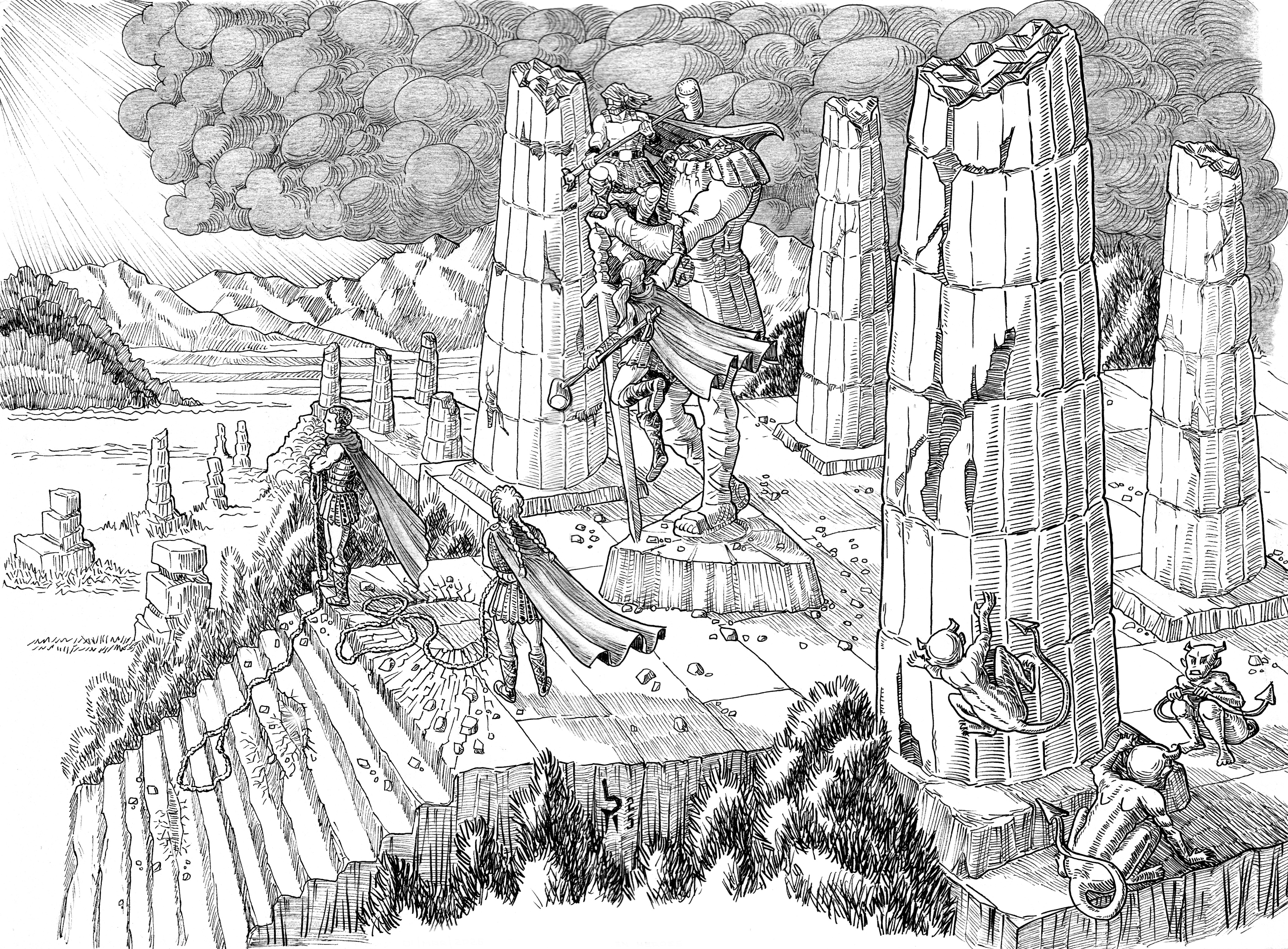
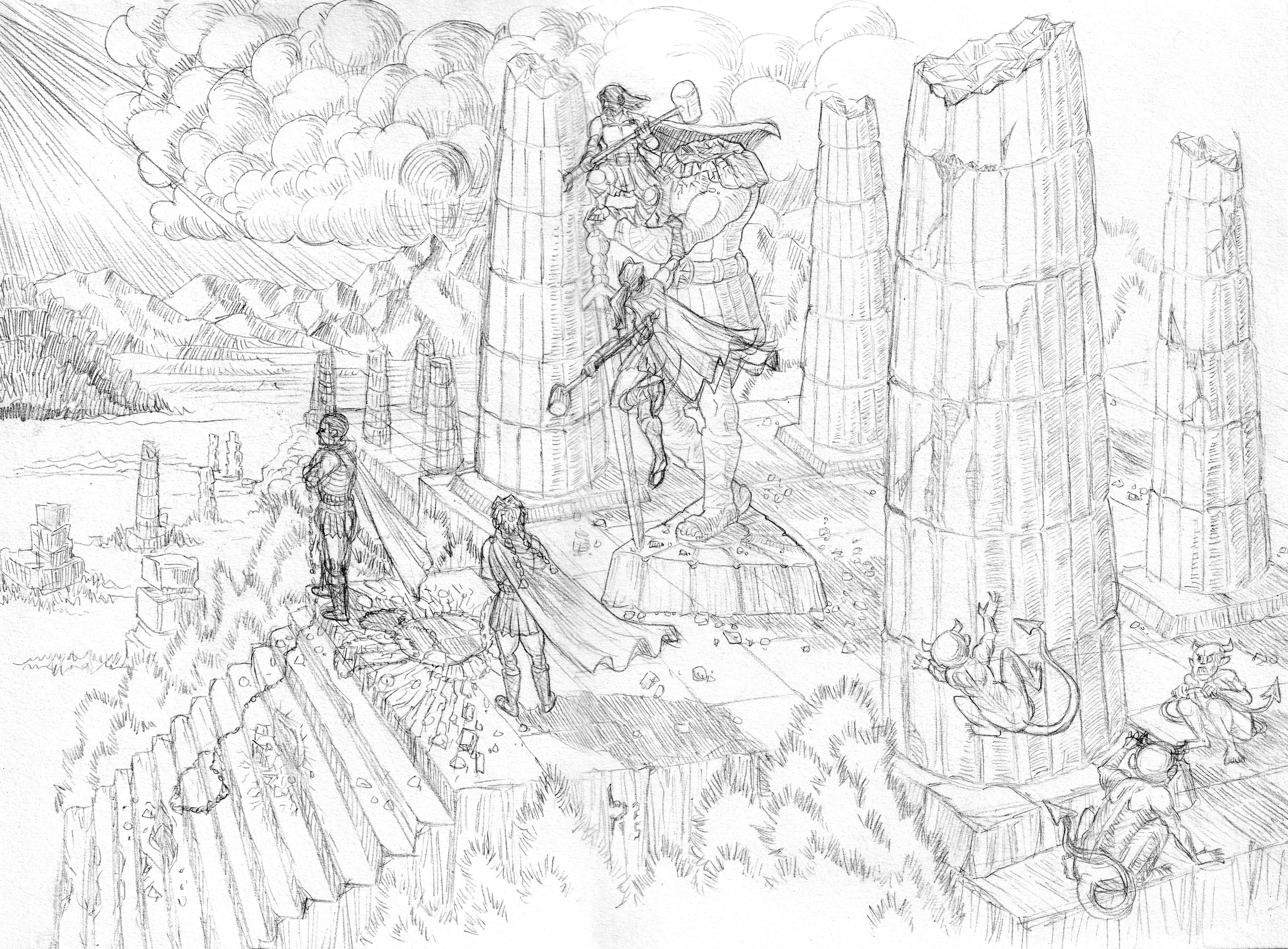
The drawing you saw above was made specifically for this essay. It depicts everything I’ve mentioned and a bit more. As you know by now, I have shared in the past my drawing method, which I recently renamed THE TRIAD DRAWING METHOD. This is mostly due to the three main phases I’ve come up with to tackle any drawing, no matter how hard or complex it feels in our minds.
The main concept for this illustration was, like the name suggests, “The Destruction of the False Hero.” I wanted to depict how the ancient status of a false hero —endorsed by old demons hiding in the corner, who watch in anger, and fear how their work is debunked— is destroyed by four unknown warriors. None of these heroes and heroines show their faces, though they are not hiding them either; they represent new core heroic values that don’t need to rely on the image of a single idol. Let’s check out the phases I went through:
1. EXPLORATION SKETCH
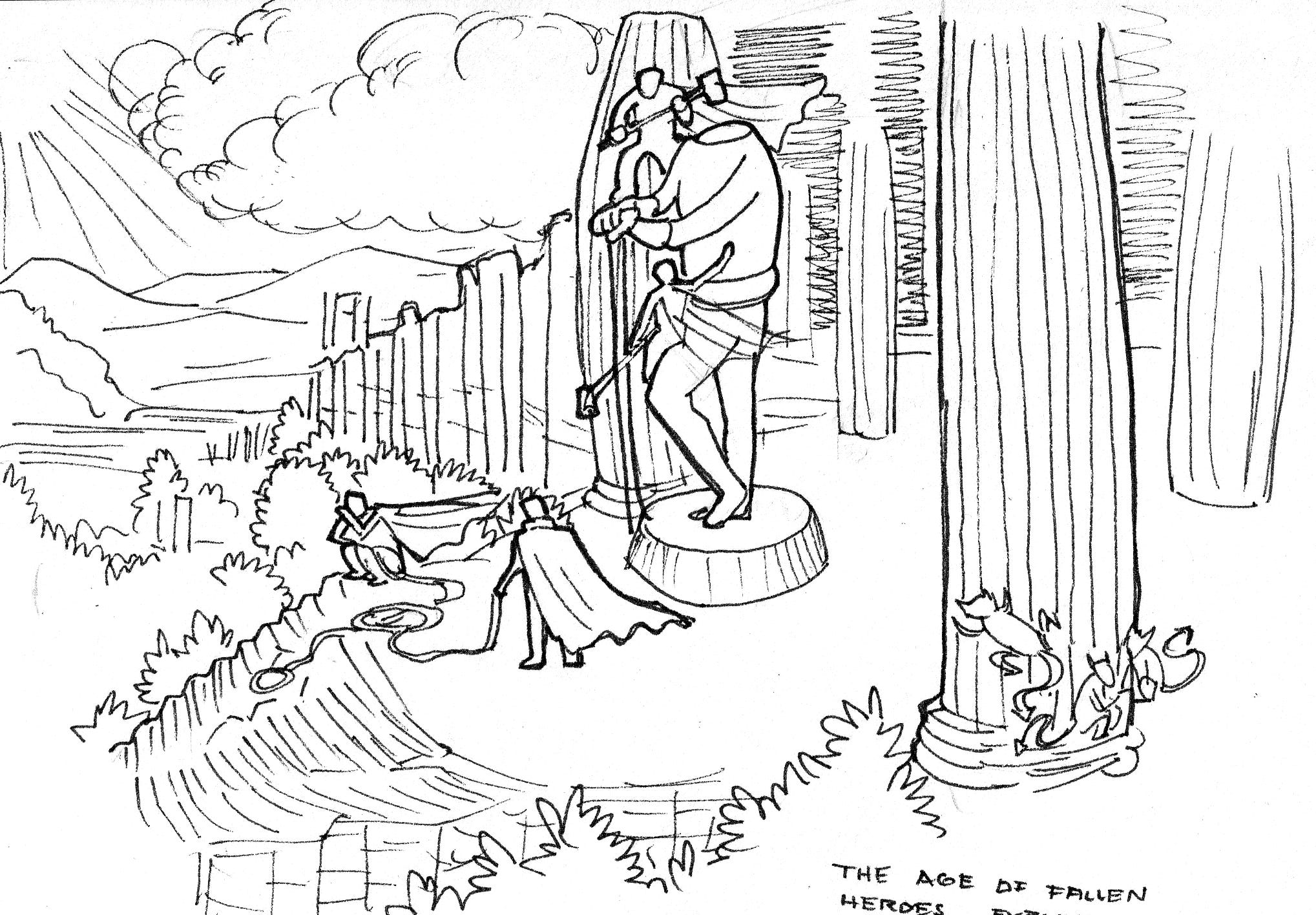
Something I particularly love about this first phase of the Triad method is how easily we can create even the most complex composition. A thumbnail sketch can be done within a few minutes, yet the most impossible of drawings can be “resolved” at this stage. For this one, I did not make more than the one you see below. That is the composition I had in my mind, and it came out mainly as I imagined it.
WORKING SKETCH
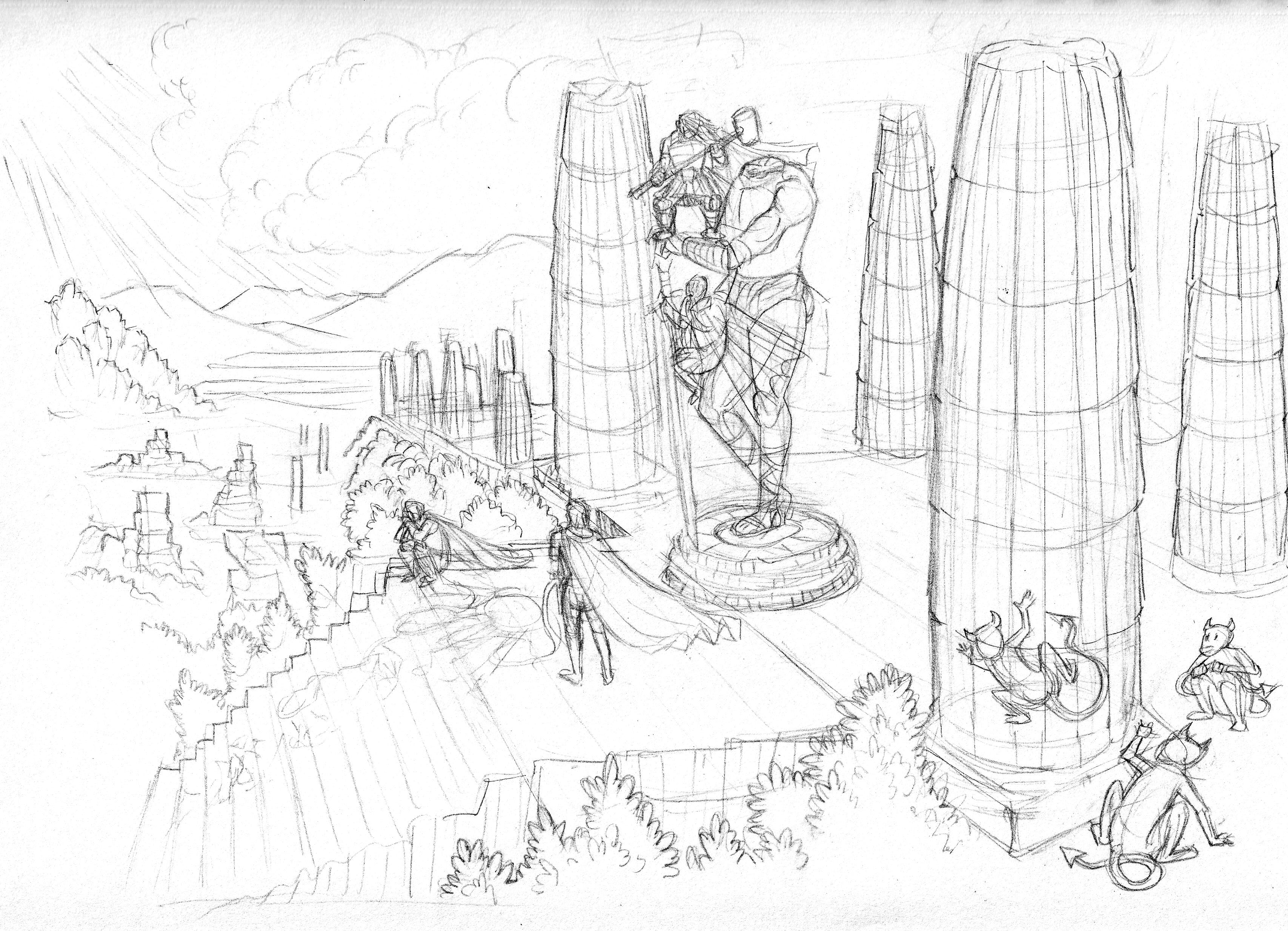
The purpose of the working sketch is to take advantage of the resolved composition, and start correcting proportions, shapes, perspectives and add the first details to it. This is also a phase where I can find out if I want to keep going, or if I need to go back and explore a bit more.
FINAL SKETCH
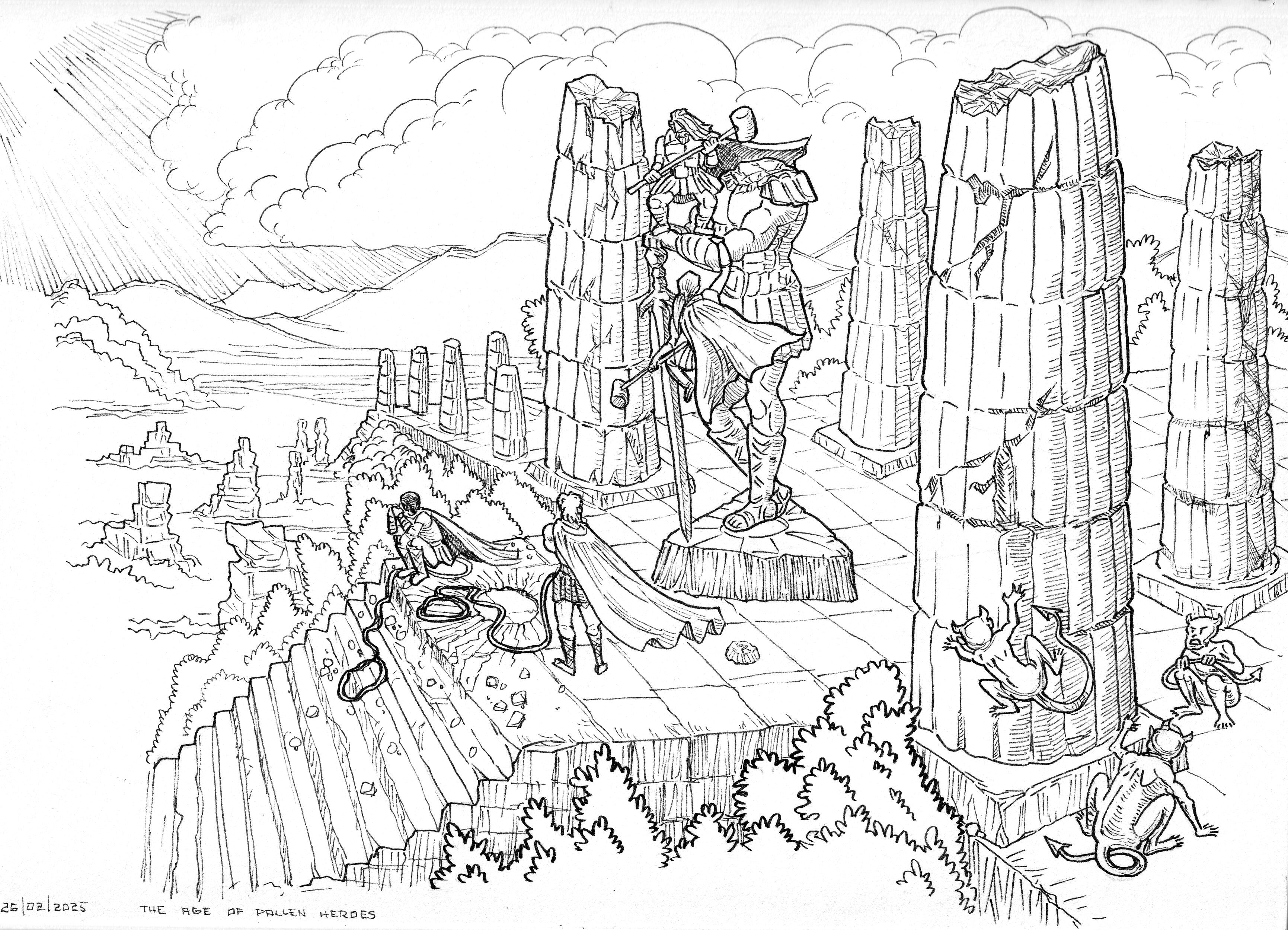
Below is the final pencil sketch before inking. While the number of details is large, the previous phases make it feel achievable. At this point, I adjusted some details (like the guy on the far left. I made him stand now, so it’s clearer that he’s staring at the sky clearing on the horizon —which represents new times coming to replace the dark ones—). Do you have a favorite detail? Let me know in the comments.
If you like my work, consider giving a like, write a comment, share, or subscribe, it means a lot to me. Until next time.
Great article and art… I myself read a lot of works by Neil, from his description of Nordic Mythology, to Sandman, Stardust and so on.
When allegations came in — I was disappointed. Yet he never was my friend or a family. He is a huge talent when it comes to literature. It seems he definitely has the “dark side,” like we all do, but, his seems quite nasty :)
Yet, I draw the line between him being a literary genius, and him as a fellow human being. I don’t have anything against a thorough investigation and him doing time, or paying large sums to the victims, whatever will be decided by the stakeholders in all of this.
But I won’t suddenly start burning his books, and engage in hate speech against him, or wear a t-shirt in public showing my dissatisfaction with one of my favorite writers.
I think people should be judged for their sins as is the tradition, culture and the laws dictate, but dumping his works into fire, or having libraries get rid of his works — is a bit extreme.
So, there’s the talented writer and there’s a deeply flawed human being. It’s not always so that these actors and writers, and other celebrities with a deep impact on the world’s culture — are model citizens, neighbors or “exalted” living beings. I wouldn’t allow anyone, unless I know them well, to watch over my pets when I am away, no matter if the person is a legendary musician or a writer, artist, actor or what have you.
Thus, I draw the line and separate the two. Similar to as with Aliester Crowley. His works are deep, well-written and his views were very unique and unlike what most famous writers of the time were writing about. Technically, he wasn’t even that famous of a writer back then, just among a very limited circle. I like him as a philosopher and a writer. The things he has done that are deeply morally questionable — is another dimension.
I don’t know if this is the ideal way of sorting through this, or that’s how everyone should behave. People free to make up their mind and do what seems right to them. If someone wishes to purge their own library — so be it, but this is not something that I will be doing personally.
Another point is that the “heroes” that haven’t been “fallen” yet — they may still fall. Or we would never find the actual evidence and learn of their transgressions for the lack of lack of sources, especially when it comes to folks going back centuries. Some of them may have been terrible people IRL, but we might never know that.
Would we decide that the Theory of Evolution by Darwin is garbage, if all of a sudden we find out, hypothetically, that he has done a series of hideous crimes?..
It seems wrong to make a cult out of anyone (besides favorite cats, naturally) — we are flawed, some are more to the extreme than others. It takes attention away from what good was accomplished. Idolizing anyone at all — just doesn’t seem wise or worth the mental energy. Often times those that do idolize others — lack a good role model, or have some kind of a psychological predisposition for such feelings. Again, what I think about it, is just what I think about it. It is a good food for thought for anyone, however.
And it’s good to explore such concepts! Thank you for your time and effort!